
Out-of-State Families With a Loved One in Florida
You live in another state. Your loved one is in Florida, and their mental health or substance use crisis has become impossible to manage from where you are.
Helping someone from hundreds of miles away is its own kind of hard. You cannot see the day to day, and every call from that area code makes your stomach drop.
You do not have to be in Florida to step in. A large share of the families we work with live somewhere else, get their loved one to Florida, and let us handle the legal side here. You can drive the whole thing from home.

Families reach into Florida from every state
You are not the first parent sitting hundreds of miles away, certain there is nothing you can do from where you are. Families come to us from all over the country, worried about a son or daughter caught in a mental health or substance use crisis, and together we work out how to get their loved one to Florida so the help can begin.
For the first time in a long time, the distance stops working against you. It is a path a lot of families have walked before you, and you will not walk it alone.
Calls like yours are not the unusual ones. They are most of what we do, and we know exactly how to handle it from here.
Parents call us from the Northeast, the Midwest, the West Coast, and everywhere between.
Out-of-state families are a routine part of this practice, not an exception we have to work around.
You stay where you are. The work in Florida is ours to carry.
How we work with out-of-state families
A good part of our practice is families in another state who need to get a loved one to Florida, where the legal side is ready and waiting when they arrive. It takes coordination and timing, and you do not have to work it out alone. Here is how it usually goes.
The first honest conversation
Before anything moves, we talk. You tell us what has been going on, how long, what you have already tried, and where your loved one is right now. We are listening for the few things that decide whether this can work, whether the substance use has reached the point the law cares about, whether your loved one can realistically be gotten to Florida, and how much time we have.
If it is a fit, we will say so and walk you through the plan. If it is not, or not yet, you will hear that just as plainly, before you spend money or set a fragile plan in motion.
Building the plan before anyone travels
These cases turn on timing, so we build the plan before your loved one ever gets on a plane. We work out who the petitioner will be, which county your loved one will be in, and what the court will need to see. The point is to have it all lined up so the legal side can move the moment it is allowed to.
We also walk your family through your part, because getting someone to Florida is usually the hardest piece, and it falls to the people who love them. We will tell you what has to be true for the court to step in, so the trip is not wasted and the timing holds.
Getting your loved one to Florida
This part is yours, and we help you plan it. Sometimes it is a visit, a holiday, or a family event. Sometimes families use a professional transport service that specializes in moving a loved one to Florida safely. What the court cares about is that your loved one is physically in the Florida county where the case is filed.
We time the legal side to their arrival so nothing is scrambling to catch up. The moment your loved one is here and the criteria are met, the plan is already moving.
Filing the petition and asking the court to act
Once your loved one is in the county, we file the Marchman Act petition. In plain terms, we are asking the court to find that the substance use has taken away your loved one's ability to make safe decisions, and to order an assessment.
If the court agrees, it can order that your loved one be taken in for that assessment, even without their agreement. This is the piece that makes the whole coordinated plan possible, and it is why the timing in the earlier steps matters so much.
The pickup and the ride to the facility
With the order in hand, your loved one can be taken into protective custody and brought to a receiving facility for assessment. In many cases local law enforcement carries this out, which is what families mean when they say the authorities are ready the moment their loved one lands in Florida.
We know how heavy this moment is. It can feel like the hardest thing you have ever agreed to. It is not punishment, and it is not giving up on them. It is stepping in when the disease has made it impossible for them to step in for themselves, in a place built to help.
Assessment, stabilization, and the treatment window
At the facility, your loved one is assessed, and the court can order a period of stabilization and treatment. That window is what gives treatment a real chance to take hold, instead of ending the minute your loved one changes their mind.
We stay in front of the court through this stretch, because the details decide a lot. What the facility recommends, whether more time is needed, and what comes next are things we handle, so your family is not trying to run a Florida courtroom from another state.
Staying on the case after the doors close
Recovery is not a straight line. People leave treatment. They stop taking their medication. That is not failure, it is the nature of this disease, and it does not mean the plan did not work. We stay on these cases for months because we expect the hard parts and we are ready for them.
Through all of it, we keep you in the loop from wherever you are, by phone and by video. You will not be left guessing about what is happening in a Florida courtroom or a Florida facility. You hear it from us, and you know your options at every turn.
Step one is a conversation, not a commitment.
Tell us where your loved one is and how much time you think you have. We will tell you honestly whether this can work.
The situations we see most
Families reach us from out of state at very different moments. See if one of these sounds like yours.
The parent in another state whose adult child moved to Florida, and whose drinking or drug use has taken over.
The sibling coordinating from out of state after a loved one was Baker Acted in Florida, trying to understand what happened and what comes next.
The out-of-state parent whose adult child is in Florida and keeps ending up in crisis, who has learned that a Baker Act or a Marchman Act runs out, and that being their parent stopped carrying any legal weight the day the child turned 18.
The out-of-state parent, often already in a Florida crisis with the same child, who wants what they leave behind to help their child, not fuel the addiction, and without cutting them out.
The out-of-state parent of an adult child in Florida whose mental illness makes steady work impossible, trying to get them the disability benefits and stability the family has been carrying on its own.
The out-of-state family settling a loved one's estate in Florida, where a sibling's addiction, or not being able to find them at all, is holding everything up.
None of these?
If your situation does not fit neatly on a list, call anyway. These cases rarely do.
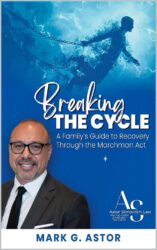
Mark literally wrote the book on Florida's Marchman Act.
Mark Astor wrote Breaking the Cycle for families trying to help a loved one who won't accept it yet, a plain-English guide to the Marchman Act built from hundreds of real Florida cases. Call our office and we'll mail you a physical copy and send the digital version to your inbox right away. Free, and yours to keep.
Why out-of-state families call us
When you are far away, you are not looking for the nearest firm. You are looking for someone who can be in the room in Florida when you cannot, and who knows how the court there actually works.
Someone in the room in Florida
Mark was a prosecutor and a defense attorney before this, so he knows how the criminal and behavioral health systems collide in Florida, and how to keep a loved one from getting stuck in the wrong one.
From another state, that knowledge is the difference between guessing and knowing.
Still here when plans change
We also stay on these cases for months, which matters even more when you cannot drive over to check on things. People leave treatment. Plans change.
We are still here when they do, and we keep you in the loop the whole way.
A straight read, not a pitch
And we will tell you the truth before you spend a dollar, including when the honest answer is that this is not the right path yet.
You deserve a straight read, especially when you are making a hard call from far away.
That is what we do. You do not have to work out the Florida side from another state.

Meet Mark Astor
These are personal problems with a legal solution, not the other way around.
Mark Astor
You will feel better once this is moving
Right now the hardest part is not knowing. You do not know whether the law can help, whether the situation is bad enough or already too far, or whether stepping in from another state will even work.
That weight does not lift on its own, and it will not lift by reading one more page. It lifts the moment you talk to someone who has seen this before and can tell you where you actually stand.